• Sort Blog:
  • All
  • Book Reviews
  • EA Rotterdam
  • Essays
  • Flotes
  • Goals
  • Links
  • Series
  • Short Stories
  • Uncategorized

Getting Things Done

What if you could get more done? What if your plans could become a reality without having to wait for years? What if you could free up your mind for important things and store your worries/to-do’s etc, somewhere else? This is what Getting Things Done (GTD) is all about.

GTD is a book for the people that like to make lists, and who would want to get their lives more organised. The process aims to clear your mind, see what’s on your plate and make it easy to decide what to do next. The end goal is to make you work on the most important things (only).

GTD is an organisational system. It’s built on five pillars (or principles).

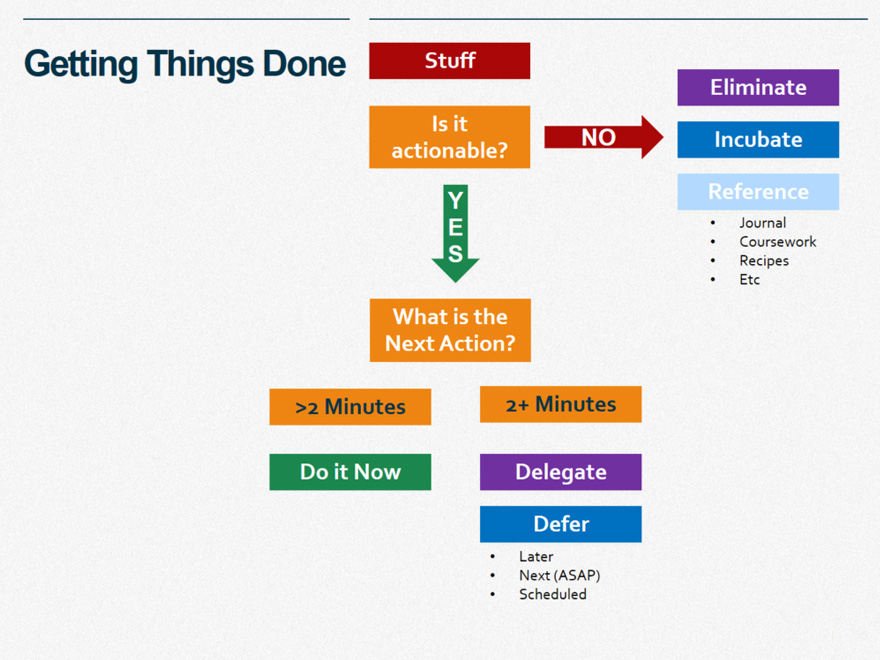
  1. Capture everything – Write down (digitally) everything that comes up. From to-do’s to brain farts, get it on paper and out of your head.
  2. Clarify the things you have to do – break everything down into SMART goals. Don’t say “I want to get bread”, better say “Tomorrow at noon I will get one whole grain bread at John’s Bakery”.
  3. Organize your actionables by category and priority – put a date on things, reminders, calendar notes, etc.
  4. Reflect on your to-do list – see what’s next, and periodically reflect if your priorities are still in the right order.
  5. Engage and get to work – choose your next action, and do it.


These pillars are the basis of GTD. You are probably already doing (some of) these steps without having even heard of the GTD method. What GTD brings to the table is a reminder of working with a system and useful tips & tricks on how to best make use of such a system.

Getting Things Done is a useful way to get your life organized. The full system is not for everyone, but I do believe it has something to offer for everyone.

The One Minute Manager

“The best minute I spend is the one I invest in people.” – Ken Blanchard


Lessons learnt: Set goals and check if your behaviour matches it. Catch someone doing something right. Be specific in your reprimands.


Managing people can be overwhelming. Sometimes you are faced with questions about motivation. At other times you are asked to give a critique. And in the end, it may all be an overwhelming experience. The One Minute Manager is the perfect book for the starting manager. It features simple lessons, sticks with one story and does not bother with difficult explanations or hefty theoretical basis. At the same time this is its weakness and for further lessons in leadership please consult some other classics like The Effective Executive.

The story in The One Minute Manager follows a man who wants to work for (and eventually become) a great manager. In the second chapter, we meet this man. He is quick with his words, does not repeat himself and seems to have it all figured it out. At the end of the meeting between the two characters, he corrects the visitor one last time. When thanked for giving him answers he replies “I did not, you solved it yourself. I just asked questions”. In fact, here lies the first lesson of the book, enable other people to think, to take command and become less reliant on you.

In the book three things are discussed: 1) goals, 2) praisings, and 3) reprimands. Here is a summary of the lessons on praising:

  1. Tell people up front that you are going to let them know how they are doing
  2. Praise people immediately
  3. Tell people what they did right – be specific

There are 4 more points, but I leave it to you to go and read those. As with more management books, the lessons may seem generic and too simplistic. At the same time, I believe that more people do not exhibit behaviour that reflects these lessons and that mastering them will be hard – for any executive.


“Take a minute: look at your goals, look at your performance, see if your behavior matches your goals.” – Ken Blanchard


After the one or two hours, it takes you to read the book, you are left 50% satisfied. As with the ‘questions’ mentioned above, the book does not tell you how to go about and implement the lessons mentioned. Of course, we can think for ourselves and it is up to you to go and become an effective executive.

The Miracle of Self-Discipline

This one of the (small) books that Brian Tracy has written. I guess that it’s good to learn these things when you start with goal-setting. But please read Triggers instead. I believe that it’s about building the right systems and that self-discipline as a skill or as a mental habit that you can will into existence is overrated.

Seeing the points below I do think that most are valid and with only about 1,5 hours of audiobook, he doesn’t beat around the bush.


Here are some points from another review:

Nine disciplines:
1. Clear-thinking
*** Fast decisions are usually wrong decisions
*** Chunk off large amounts of time for thinking
*** Think on paper; write it all out
*** Wisdom = Experience + Reflection (Confucius)
*** Keep your thinking open

2. Daily Goal-Setting
*** Focus and concentration are indispensable to success
*** If you cannot focus and concentrate, then you will have to work for someone else… who will make you focus and concentrate, who will supervise you.
*** Never work on less than 10 goals per year.
*** Write these goals in a spiral notebook every morning and reprogram your mind every day.

3. Daily Planning
*** Every minute spent in planning saves 10 minutes in execution
*** Just keep working your plan
*** Discipline yourself not to do things of low-value
*** Daily eliminate/delegate any task which does not have serious consequences that only you can do
*** Start your A-1 task first every morning and stay with it until that task is done

4. Courage
*** Force yourself to do what you know you should do
*** Practice courage whenever courage is required

5. Excellent Health
*** Start off with a clear picture of your perfect body
*** Exercise every day

6. Saving & Investing
*** “Compound interest is the most powerful force in the universe.” – Albert Einstein
*** 2/3 of success in investing and business is avoiding making mistakes

7. Hard work
*** Work all the time you work. Don’t waste a single minute.

8. Continuous Learning
*** Read in your field daily
*** The more you learn, the more you earn

9. Persistence
*** Drive yourself forward to complete your tasks 100%
*** Persistence is self-discipline in action
*** “Persistence is to the character of a man like carbon is to steel.” – Napolean Hill
*** Your persistence is your measure of your belief in yourself.

Delivering Happiness

Is money more important than building something great? Tony Hzei thinks not, he believes that building culture is more important than making the highest profits. In Delivering Happiness you can read Tony’s story. The book is half autobiography, half company bio. Although not the most common combination, I believe it works. The book is inspirational, fun and a bit quirky.

What I like is that his focus is not on the money, and maybe not even so much on the customer, as on the employees and enabling them to make great choices (to help the customer and the money part of it).

Seeing his later ventures I don’t know if Tony is the best businessman. But he sure has the heart in the right place and his story is one to take note of.

The Black Swan

“Past performance is not a guarantee of future returns.”  – proverb

Lessons learnt: Highly improbable events have huge impacts on our lives. We are very – or exponentially – bad at predicting the future. Awareness is the first step in becoming ‘future-proof’. 

If we look back on the housing bubble that was created before 2008, most of us would recognise the risk and overpricing that was going on. But back then almost no-one saw it coming, prices were rising for years and everyone had money to pay their bills. When everything eventually collapsed it put most of the world into a financial crisis of which we are only recently recovering. This kind of event is something that with hindsight we might think we may be able to predict, Nassim Taleb argues that beforehand we are totally in-the-blind. In The Black Swan, he explains why we cannot predict the future, what the impact is of highly improbable events and how we may protect ourselves from them. The book introduces groundbreaking concepts but sometimes is too long-winded.

People seek validation, in most cases, we are looking for facts that support our current models. This happens in everything from interrogation room to historical searches. Psychologists have been fascinated by this concept and have called it the ‘confirmation bias’. Before the housing boom we expected prices to keep rising, they did not. People also like to make models, we want to fit all the information that is available in the world into simple-to-understand frameworks where we can make sense of what is going on. But putting things in models also means sacrificing information for the sake of simplicity.

Nassim Taleb’s biggest problem with models is the Bell curve. A Bell curve (or Gaussian function) assumes a normal distribution, where events on the far left or right are deemed very unlikely to happen. With the Bell curve itself Taleb does not disagree, he disagrees with the interpretation. Most of the time people discount the extremes, in psychology you are even actively encouraged to not consider the outer 5%. Even in the ‘very rational’ field of Finance, investors rarely put their money up for the thing that is very unlikely to happen. Then came 9/11.

In one of the many stories mentioned in the book, Taleb describes an investor who bets on the ‘long tails’ (the outer 5%). The investor is steadily losing money, but at the same time, he knows that one of these days something very unexpected will happen, this is where he will make his money. This does not mean that the investor had the ability to look into the future, nor that he had any negative feelings towards Americans. It only meant that he saw that ‘rational’ investors were ignoring the long-tail and that he could make money there.

“Things always become obvious after the fact” – Nassim Taleb

So what is the impact of these Black Swans? They are rare, unexpected, but very big. Black Swans are events like the assassination of Franz Ferdinand, the rise of Hitler, 9/11, but also the rise of the internet, and (of course) the discovery of black swans in Australia. A Black Swan can upheaval a system that has been in place for decades (e.g. the fall of the Soviet Union) and will influence people for many years after it has taken place (all Black Swans).

Talking about unpredictable events is very interesting and difficult at the same time. After five paragraphs I have barely made it through the first part of The Black Swan. The book itself also struggles to keep the centre concepts from drifting into specifics about finance or how storytelling can take facts out of context. For the very busy people, I would advise you to read only the first part, for everyone else please do make it through the whole book. You will learn to protect yourself from negative Black Swans and in the process also learn about fake ‘experts’, Umberto Eco’s Antilibrary and randomness. Be sure to read it when convenient. ps “Remember that you are a Black Swan” – Nassim Taleb

More on The Black Swan

http://www.goodreads.com/book/show/242472.The_Black_Swan – Other Reviews on Goodreads

http://en.wikipedia.org/wiki/Black_swan_theory – Wiki on Black Swan Theory

http://www.riosmauricio.com/wp-content/uploads/2013/11/Taleb_The-Black-Swan.pdf – .pdf of The Black Swan

pps I think that Nassim Taleb has gone off the deep end a bit lately (2018), but I do very much agree with the validity of this book!

The Better Angels of Our Nature

The Better Angels of Our Nature by Steven Pinker is a long, long, book. So, I said it. I read over 50% of it and then listened to the rest as an audiobook. The book is full of great knowledge but also doubles as a reference work where Steven explains every detail until it hurts.

One thing I took away from the book is that the world is better than ever before. There is no need for nostalgia, in every regard possible (and most definitely in aggregate) we have it better than ever before. Fewer people dying from diseases, murder, rape, starvation. More options, more wealth, more rationality.

And no, not everything is going perfect, but we’ve come quite a way.

One point where Steven Pinker disagrees/highlights a different point is his optimism for the world, versus the view of Nassim Taleb (Black Swan). Steven argues that the underlying constructs of society have become better, that those factors contribute to our wealth and health. Whilst Nassim argues that very bad events can still happen and that we may just be riding a positive wave. I tend to agree with Steven and like to also believe (based on the statistics) that we are heading in the right way.

Does that mean that we are without danger? No, of course not. Nuclear weapons, bioterror, AI, there is a lot to be afraid of. Yet at the same time, we have the most resources available to get ourselves going again and the least incentive to do harm.

I haven’t started Enlightenment Now, but I might recommend that over this one if the message is similar and has less focus on the underlying arguments/history.

High Output Management

High Output Management by Andrew Grove is one of the management classics, and rightly so. The main insight I took away from the book is that the output of a manager is the output of his team/whom he influences. This sheds new light on the usability of meetings, what the impact is of decisions, and how you should plan.

In the introduction, Andrew speaks about time as being the competitive advantage. I like this both for the business perspective (i.e. how to leverage your time), and for personal life (how to get the most out of your time).

As a manager, you want to be working on the thing that has the most leverage. For instance, if you make one decision that influences the work for the coming months, that is a high leverage activity. Or if you give a training to 200 employees who will then work more effectively, that is also high leverage. Andrew argues that information gathering is also part of this equation.

Another insight from the book is that we need to plan ahead. What are the things we can do now so that we don’t have to do X (Y and Z) later? For instance, if you review a draft of some work, you may give it another direction without having your employees waste time making the finished report and then changing it.

One thing I found in the book, and in my goals, was the idea of having slack in the system. So that when a thing comes up you can deal with it and not let everything go sideways.

Andrew argues for a system of Management by Objectives (MBO) or more precisely Objectives and Key Results (OKRs). (also see this TED talk by John Doerr) And Measure What Matters.

  1. Where do I want to go? (objective)
  2. How will I pace myself to see if I am getting there? (key results)

He states that the system should be for relatively short periods of time (quarterly or monthly). Luckily that is something we do at Queal.

There is even more good stuff in the book, but then you will have to read it yourself!

Start With Why

Start With Why (TBD) Simon Sinek


“There are two ways to influence human behavior: you can manipulate it or you can inspire it.” – Simon Sinek

Simon Sinek gained his fame with his three questions: why, how, what? Here is his very elegant framework


Inside-Out

We should start with ‘why’ and work outwards from there. Simon Sinek dubs this the remarkable way of thinking about your company/message. This is in direct opposition to how most companies are used to define themselves, working outside-in (the conventional approach). He builds on the divide between brain structures, speaking to the limbic (primitive – why, how) part of the brain that controls decision making and emotion, instead of the neocortex (human) part that controls rational thought.


Why

Very few organizations know ‘why’ they do what they do. ‘Why’ is not about making money or increasing share prices – that is a result. It is about the purpose, cause or belief. It is the very reason an organization exists.

How

Some organizations know ‘how’ they do it. These are the things that make them special or set them apart from the competition.

What

Every organization knows ‘what’ they do. These are the products they sell or the services they provide.


Examples

  1. Simon Sinek uses Apple as an example in his famous TED Talk – why: we believe in challenging the status quo and doing things differently – how: our products are beautifully designed and easy to use – what: a product called the iphone/ipad/iwatch/etc.
  2. Here is Google – why: to organize the world’s information and make it universally accessible and useful – how: thanks to our ability in creating algorithms – what: that help us offering you several search resources in every possible device
  3. De Kleine Consultant – why: to bring advice where it normally does not reach and train students – how: by offering a development platform for outstanding students – what: non-profit consultancy projects under the guidance of a multinational strategy consultancy


When to Use

The Why-How-What framework (also called the Golden Circle) can be used for defining the reason your company exists. It can be used to increase both rigidity (in your vision/core competences – the why and how) and flexibility (in your final products – the what).

A More Beautiful Question

“Always the beautiful answer. Who asks a more beautiful question.” – E.E. Cummmings


Lessons learnt: Questions are as important as answers (or possibly even more important). Ask why, what if, and how. What if questions could lead to better actions?


Why Question in the First Place?

Time is a most precious finite resource. Most people (in business) are always busy. Business leaders are always anxious to act and do. But they forget to question just if what they are doing is the right thing. In A More Beautiful Question, Warren Berger argues that we should take more time to think and ask questions.

Berger argues for a very specific type of questions to ask: Questions that are ambitious yet actionable and that can change the way we perceive or think about something. These questions should be hard (and interesting) to answer, but easy enough that you can still answer them. In short, you should start asking beautiful questions.

With beautiful questions, you can achieve many great things. In scientific discovery, it’s questions that lead to discoveries. Questions can tackle your assumptions and prejudices. And questions can help you better invest your time in useful activities.

The Power of Questions

One meta-quality of questions is that they allow you to think about what you don’t know. This is how innovation is driven, asking small incremental questions that lead to ever newer prototypes. Berger condenses the link between questions and actions as follows: Q (question) + A (action) = I (innovation). In observing these innovators he noticed three types of questions: why, what if, how. More on this later. First, why aren’t we asking more questions?

In an amazing TED Talk by Ken Robinson (watched 31 million times), he speaks about how schools kill creativity. Schools rate kids on set criteria (sometimes measuring a fish on its ability to climb a tree) and frankly prepare them for a world that is long gone. When kids go to school the number of questions they ask drops radically. Kids are taught to memorize lists, not think critically.

Berger agrees and states that what schools are for is to prepare students to be productive citizens in the twenty-first century. “This requires self-learners, who are creative and resourceful, who can adjust and adapt to constant change.” Luckily some schools do adhere to the questions etiquette and from Montessori schools, the likes of Larry Page (Google) and Marissa Mayer (Yahoo!) have risen to greatness. Therefore we should increase the number of questions we ask and at the same time learn to ask the right kinds of questions.

Beautiful questions can be divided into three parts: why, what if, how.

  1. Why: stepping back, stop doing and stop knowing*
  2. What if: you don’t do that, combine A and X
  3. How: will it work, just do it

From question to execution these three types of questions can help you better execute your plans, focus your actions and improve your results. Now let’s look at how you can use beautiful questions in business and life.

Questioning in Business

The legendary business guru Peter Drucker understood that his job wasn’t to serve up an answer. He argued that he had to “be ignorant and ask a few questions“. Questioning in business works best to see things from a different angle, challenge your own assumptions, and reframe old problems. Here are three examples of businesses that use beautiful questions:

  • Google: every Friday all employees (from each level) can ask questions to Larry Page and Sergey Brin. In a Reddit-like style of up- and downvoting the most interesting questions get an immediate answer.
  • 3M: all employees can take 10% of their working time to answer questions they would like to explore.
  • Panera Bread: what does the world need most … that we are uniquely able to provide? (transforming a company into a cause)

Questioning for Life

“What is your sentence?” This is what Congresswoman Clare Booth asked John F. Kennedy at the beginning of his career. She believed that great people should be summarized (and remembered by) something that fits onto one sentence. One example would be “He raised four kids who became happy, healthy adults”. What would your sentence be?

Another way of putting the question is: Why are you climbing the mountain? What is it you are fighting for? What if you just gave it a shot? What if you couldn’t fail? How would you end up? How would you feel?

I can’t answer the questions for you. But I can ask you to use the power of inquiry to examine your life, to question your motivation, and to use questions for the greater good.

“The wise man doesn’t give the right answer, he poses the right questions.” – Claude Levi-Strauss

The Question: Is it worth the read? (yes)

After our first few years in this world, we stop questioning. We ‘go with the flow’ and become boring grey sheep. Sometimes it only takes a question to become the shepherd. In A More Beautiful Question, you will be prompted to start asking questions.


* Asking why can be done with the five whys methodology. This simple technique forces you to find the deeper reasons for your (or other peoples) actions and convictions. This can uncover hidden motivations and result in better solutions to your problems.

A Random Walk Down Wall Street

“An investment in knowledge pays the best interest.” – Benjamin Franklin

Lessons learnt: Invest in passive index funds for a very long time with money you won’t need until retirement!

Stocks go up and stocks go down – that’s about it for my knowledge on stock markets. In A Random Walk Down Wall Street Burton G. Malkiel argues that I’m not too different from almost all financial ‘advisers’. After reading the book your knowledge has however gained two very important pieces of information:

  1. Stocks tend to go up in the long run (by as much as 8%)
  2. You (nor your fancy broker) can predict stocks in the short (to medium) term

In 400+ pages Malkiel will take you on a journey through topics like stocks and their valuehow the pros invest, and how you should invest. In the end, you will be able to separate the wheat from the chaff and start making your next investment decisions.

Random Walk

A random walk is one in which future steps or directions cannot be predicted on the basis of past history”. Malkiel argues that the past performance of a stock is no guarantee for future performance. He argues that a monkey throwing darts will do as well on the stock market as your next best financial ‘expert’. And he has historical data backing him up.

Throughout the 400+ pages you will be introduced to a myriad of examples, let’s discuss only one here. Let’s say that you have the opportunity to choose between investing in Apple or Microsoft. The first has grown (or stagnated) steadily for many years. The second has grown much in the last decade. Which one would you choose?

Many people would – I think – choose Apple. It’s cool, hip and trending. It has outperformed Microsoft and many other competitors. And it’s stock has been on the rise for a long time. So what could go wrong? That is exactly the same thing as people thought about internet companies at the beginning of the 2000’s – right before the dot-com crisis.

And I’m not saying Apple is a bad company. I’m saying that you don’t know if there is another Tech bubble forming, or that there won’t be any strikes at the manufacturing plants of Apple. I’m saying that the past performance of Apple (or other companies) is no guarantee for future performance. And to the question which one of the two I would buy, probably both – in an index fund.

Rationality

Malkiel argues that stock markets are rational and that’s where I disagree with him. In one of the first chapters, he writes about tulip crazes in early 1600’s – prices that didn’t correspond with reality. Later on, he describes the housing bubble, dot-com crisis, etc, etc. So how can he defend the Efficient-Market Hypothesis?

He does so by changing the argument on which a price of a stock should be based. He states that it’s about how much people are willing to pay, not X times earnings. He argues that markets will always correct themselves and that pricing is only of for a short time.

I wish to disagree (psychology graduate speaking here) and argue that psychology has much more to do with it than Malkiel lets shine through. Yes, he devotes one chapter to behavioural economics and recognizes that people are not rational. But he forgets that effects like sunk-costs influence not only the stocks people hold onto, they also affect everything from building projects to marriage duration. I would even argue that our irrationality influences how we code the computers that we let do our bidding – so I can’t understand how Malkiel argues that the markets are rational.

“How many millionaires do you know who have become wealthy by investing in savings accounts? I rest my case.” – Robert G. Allen

Investment Advice

What I do believe and appreciate is his investment advice. Although Malkiel believes in rational markets he also fully understands that predicting the future of stocks is like rolling a dice. You can’t predict which number you are going to roll, but you do know that on average you will throw 3,5 (or 7 with two dice). And so it is with stock markets, you don’t know the short term but you do know that it will go up in the long term.

Therefore you should invest with longevity in mind. Invest only money that you don’t need to access for a very long time. Let the magic of compounding interests work for you and see how twenty years of 8% interest leads to a 366% increase in your money (and not 8*20=160%).

Investing should also be passive (again – you can’t predict short-term effects for individual stocks) and in an index fund. For the long term, you won’t be able to predict if Apple and Microsoft will still be around, but you can (more safely) assume that the stock market will have grown.

To sum up, all the advice and fine details of A Random Walk Down Wall Street wouldn’t do the book justice. As a starting investor, the book has helped me a great deal to better understand the ins and outs of stocks. The practical advice is very actionable (but uses American examples) and will definitively also help you further!